
Companies in Focus: Boreal Orchards Rebuilding Nature with Lab-Grown Moss from Northern Sweden
In our article series Companies in Focus, we continue to highlight companies in northern Sweden that are turning ideas into sustainable solutions. This time, we meet Boreal Orchards, a company developing a new method for restoring damaged land using locally cultivated moss and nature-based technology – attracting growing international interest.
--------
Boreal Orchards Rebuilding Nature with Lab-Grown Moss from Northern Sweden
Few people think of moss as something important. Yet it is one of the planet’s most advanced and resilient organisms – a biomaterial that has survived every climate cycle, every ice age and every major catastrophe for 500 million years. It is therefore not surprising that the Umeå-based company Boreal Orchards uses moss to restore damaged land around the world.
Boreal Orchards is developing a method that could transform the conditions for land restoration in mining areas, after wildfires, following extreme weather events and in major infrastructure projects. At the center is an organism that nature itself has used for half a billion years to restart life and create fertile ground – moss.
Daniel Pacurar, founder and CEO, has a research background in plant genetics, horticulture and ecosystem development. Today, he runs Boreal Orchards from Umeå Biotech Incubator, where the company cultivates local moss species in bioreactors and develops scalable, nature-based solutions.
Daniel currently travels extensively around the world, championing moss-based restoration, building partnerships and promoting the company’s solution – earning him the nickname “The Mossman.”
He sees the important role moss plays for the planet and argues that when it comes to climate solutions, there is no need to reinvent the wheel.
“Why should humans overthink things? Moss is the most natural solution we have. Wherever nature has been disturbed, moss is always the first organism to return. It builds soil, retains water, stabilizes land and enables other plants to take over. Nature has shown how it should be done – we simply help the process begin earlier,” says Daniel.
Last year, he was invited to speak to world leaders at the UNCCD COP16 climate summit in Riyadh, Saudi Arabia, which aimed to combat drought and desertification. An estimated 1.5 billion hectares of degraded land are expected to require restoration by 2030.
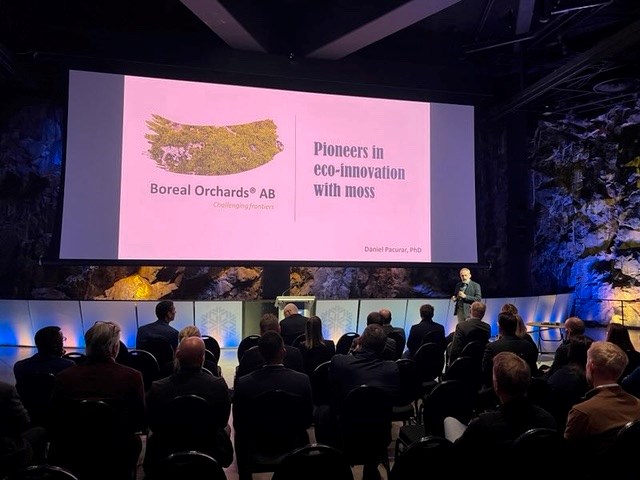
Daniel Pacurar travels the world presenting Boreal Orchards’ land restoration solution.
An Ancient System at Modern Scale
Moss exists everywhere on Earth and serves a vital function. From landscapes at sea level to high mountain peaks, in deserts, along railway embankments and on former mining sites. Mosses are among the most resilient organisms on Earth. They can grow in temperatures ranging from approximately –15°C to +40°C, and in a desiccated state some species have survived extreme cold down to –272°C. This is part of the explanation for how they have persisted through the Earth’s most extreme climate changes over 500 million years.
That robustness is also one of the reasons they are still found across the planet.
It retains moisture like a sponge, mitigates the effects of heavy rainfall, captures dust and particles, and builds the first layer of soil where nature needs to re-establish.
The challenge is that moss grows slowly. Restoring a larger area – particularly after mining – can take decades.
In Boreal Orchards’ unique method, moss is cultivated in bioreactors and transformed into a biologically active slurry, a “moss primer,” which is sprayed over the land to accelerate natural regrowth.
“We always use moss that already exists locally. It is not invasive and integrates naturally into the local ecosystem. We simply accelerate a process that would otherwise take 50 to 100 years,” says Daniel.
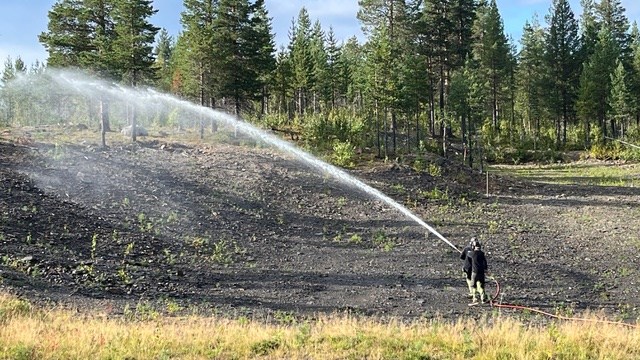
With Boreal Orchards’ unique method, a biological “moss primer” is applied to stabilize land and enable re-establishment.
International Attention
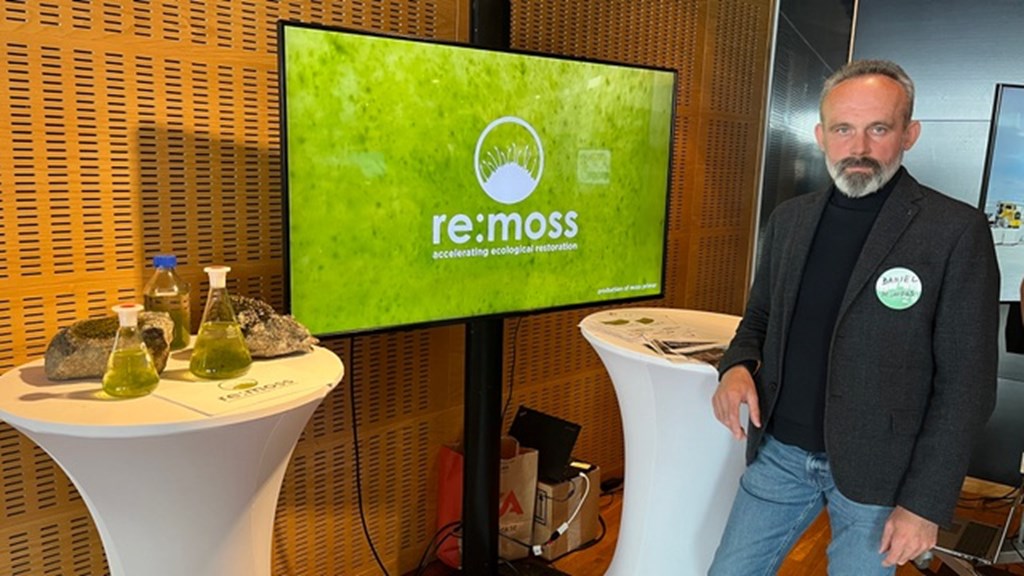
Boreal Orchards’ Vinnova-funded re:moss project, carried out together with LKAB, Boliden, Talga and Viscaria, aims to develop a new standard for post-mining landscape restoration – a method that restores land faster, works in more types of environments and requires fewer resources than traditional approaches.
At the same time, collaboration with the mining industry in Canada is also expanding. A new large-scale project has recently secured funding, with more partners than before and international participants.
These are therefore exciting times for Boreal Orchards.
“We are only at the beginning. Moss works in places where other restoration methods have not succeeded, and it can be combined with many technologies. That is why we are receiving inquiries from Canada, Chile, Australia and regions working to combat desertification,” says Daniel.
In addition to mining-related projects, the method is also being tested in major infrastructure initiatives – where moss helps stabilize land, reduce dust formation and create conditions for vegetation in exposed areas.
Rebuilding Nature from the Ground Up
The work involves more than production technology. Boreal Orchards works step by step, with field tests, analyses and local partners. Each environment requires its own solution.
“We can contribute technology and expertise, but to truly restore landscapes, local organizations and long-term commitment are also needed. It takes time, but when it succeeds, both nature and communities regain something that has long been lost.”
Daniel compares the process to planting a tree.
“They say the best time to plant a tree was twenty years ago. The second-best time is now. The same applies to moss. The earlier moss is introduced, the faster the ecosystem has a chance to recover,” he says.
Click here to read more about Boreal Orchards!
Photo: Boreal Orchards