
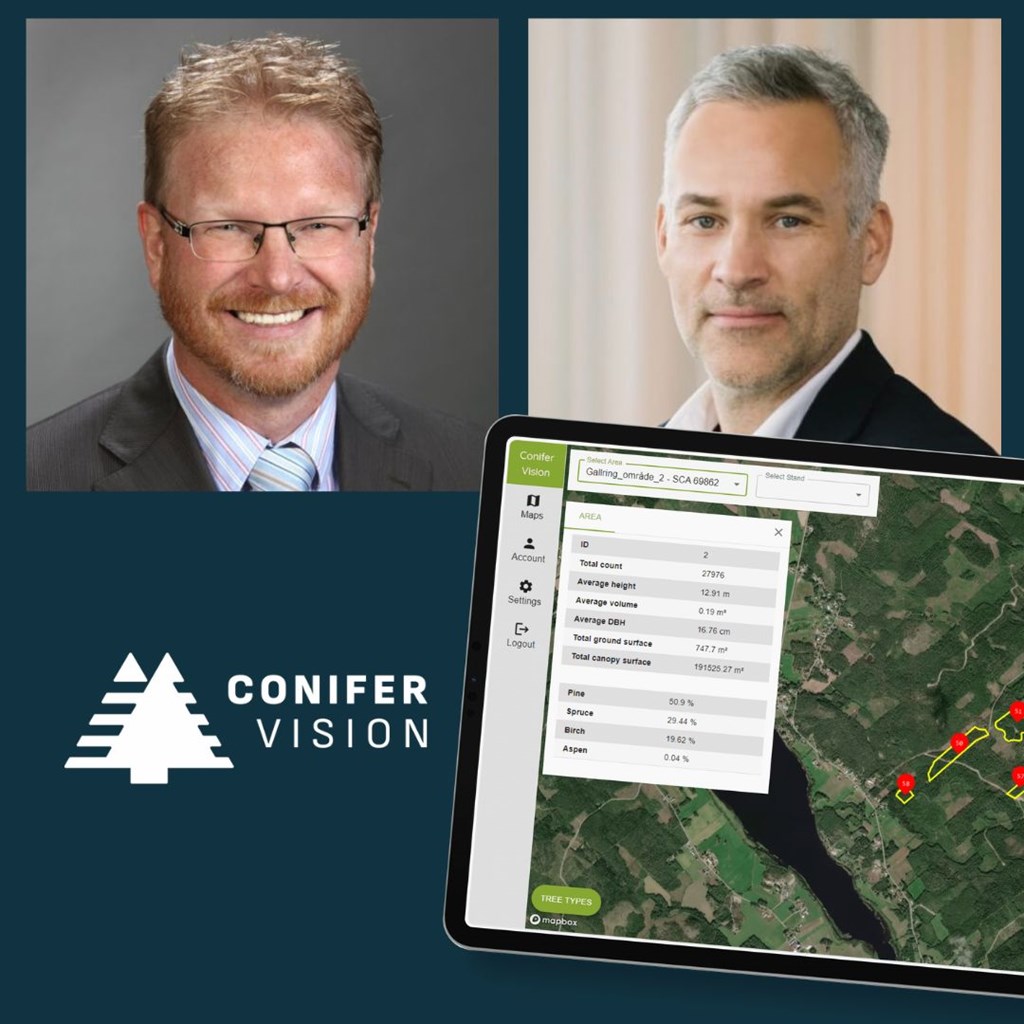
Companies in Focus: Conifer Vision Is Transforming Forestry from the Ground Up
In the Companies in Focus article series, we highlight companies in northern Sweden that turn ideas into real, sustainable solutions. In this edition, we meet Skellefteå-based Conifer Vision, which is transforming how forests are inventoried, analysed, and managed through advanced image analysis, drone data, and AI—with major implications for both forestry and societal infrastructure.
--------
Conifer Vision Is Transforming Forestry from the Ground Up
Forest inventory has long been one of the most analogue elements of Swedish forestry. Measuring tapes, sample plots, and manual assessments have guided decisions in an industry that manages enormous values—economically, climatically, and biologically. Now, the Skellefteå-based company Conifer Vision is taking a step that fundamentally changes the conditions. Their technology is so effective that Svenska kraftnät is now in dialogue about a larger collaboration—a potential breakthrough that could have significant impact on both forestry and societal infrastructure.
Founded by Roger Öhlund and Jonas Granström, Conifer Vision uses advanced image analysis, drone data, and AI to create detailed 3D models of forests and track the development of each stand in real time. The technology can identify individual trees, analyse species distribution, measure height, crown size, and carbon sequestration—and do so at a speed that no traditional method can match.
“The value isn’t in the drones. It’s in the data that’s collected and how we analyse it with our AI. It took a couple of years to build the model, but now it’s really coming together, and we have a completely unique platform that is already being used by large forestry companies to analyse their forest and land,” says Roger Öhlund, Chief Strategy Officer and Chief Marketing Officer.
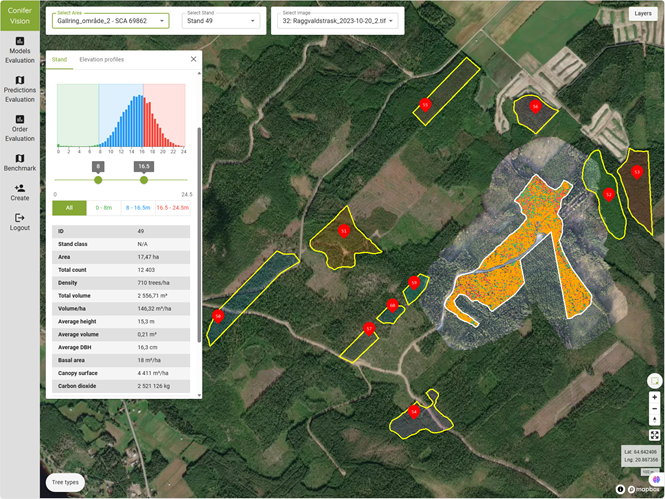
Conifer Vision has a unique platform for analyzing forest data.
A Digital, End-to-End View of the Forest Lifecycle
Conifer Vision works across the entire forest lifecycle—from site preparation and planting to clearing, thinning, and final felling.
After site preparation, Conifer’s analyses can show exactly how much of an area has been treated. Ahead of planting, regeneration potential can be assessed to identify where seedlings will have the best conditions. Once seedlings are established, plant analysis delivers complete regeneration inventories—including heat maps showing where supplementary planting is needed.
During clearing, hundreds of thousands of stems are automatically identified and sorted by species, height, and diameter. The clearing analysis indicates how many trees should be removed, how many retained, and how long the work will take. Areas can also be divided so work crews know where terrain is easier and where more resources are required.
Speed Changes Everything
In the thinning phase, Conifer Vision can analyse moisture conditions, variation patterns, and local species distributions. The thinning analysis measures each tree’s crown coverage and calculates how much carbon it has sequestered over its lifetime. When it’s time for final felling, detailed data is available on cubic volume, average height, stem diameters, and total CO₂ storage.
The major shift is about time. Traditional inventories are often based on sampling that covers only 1–2 percent of an area, creating an annual inventory deficit of more than 230,000 hectares in Sweden.
Conifer Vision can instead inventory 400–500 hectares per drone pilot per day.
“This is where the industry starts to realise the value. When we show that certain tasks can be done hundreds of times faster while delivering more data, the focus shifts to what AI-driven analysis actually makes possible,” says Roger.
One of the clearest examples comes from discussions with Svenska kraftnät. When calculating compensation for land intrusion, the traditional method involves walking long distances with a ruler and spray paint—work that can take months. Conifer Vision completed the same stretch digitally in a single day.
“This is among the most important applications we’ve worked on. When we can demonstrate full precision, identify and interpret every stem according to the regulatory framework for intrusion valuation, and do it in a fraction of the time—that’s when people truly understand the difference AI technology makes.”
Multiple Benefits for Sustainable Forestry
Conifer Vision’s technology is also used to identify biodiversity, deadwood, storm-sensitive trees, and soil conditions. This makes the analyses relevant for climate reporting, certifications, the mining industry, and the infrastructure sector.
“Forestry is really a broader issue. It’s about how we use land, how we plan resources, and how we avoid unnecessary conflicts. Better data leads to better decisions—whether you’re a forest owner or a government authority,” Roger explains.
International Expertise
Roger has a background as a technical physicist and aerospace engineer, has worked internationally, and comes from a forest-owning family himself. This combination of technology, business development, and hands-on forestry knowledge laid the foundation for Conifer Vision.
Today, the team consists of the founders and a number of developers working closely together, and the company is preparing to scale up. They have joined the Forest Business Accelerator and are currently conducting an investment round to scale their solution and integrate it with the systems of major forestry companies.
“The goal is for the tool to become a natural part of how forestry is managed. What we demonstrate today would have been impossible just a few years ago. Now it’s about bringing the technology to scale and making sure it’s put to use.”
With a growing customer base in forestry, mining, and infrastructure—and strong interest from Svenska kraftnät—Conifer Vision is entering an exciting phase of development.
Click here to read more about Conifer Vision!
Photo: Conifer Vision