
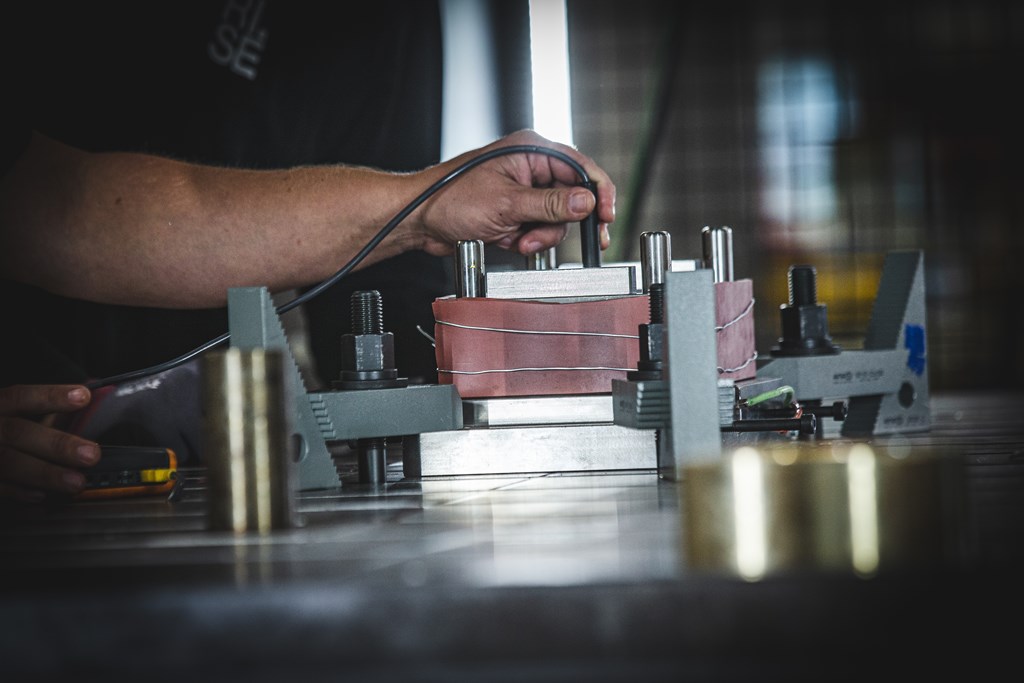
Green Testbeds Part 8: Composites at Industrial Scale
In the next part of our series on Northern Sweden's green testbeds, we head to Piteå, where RISE is advancing composites from niche materials to scalable industrial solutions. With facilities covering everything from early-stage validation to production-scale testing, companies can develop next-generation materials where performance, cost and lifecycle considerations go hand in hand.
--------
Composites at Industrial Scale
Composites have long been associated with sports cars, aerospace and high-end specialty applications. Today, the challenge is different: delivering the same performance at industrial scale — with strict demands on cost efficiency and durability. At RISE in Piteå, composites are developed with the full lifecycle in focus, from concept to finished component.
“The most rewarding part is when someone walks in with an idea and leaves with something tangible,” says David Engberg, Programme Manager for the testbed.
With a background in production engineering and nearly four years at RISE, Engberg brings a distinctly industrial perspective.
“Working with composites takes time. Small series aren't necessarily expensive, but when you scale up — particularly for the automotive industry — processes must become significantly more cost-efficient. That's where we add value.”
From Idea to Investment-Ready Data
The testbed supports companies throughout the entire development journey — from material selection and concept validation to component testing, process optimisation and near-production trials.
“In automotive, new suppliers and solutions are constantly being introduced. You need to know early on whether an idea is viable. What's required to move forward? What's missing? We've built capabilities that cover the full chain.”
Beyond technical feasibility, the focus is on enabling real business decisions.
“We provide calculations and design data, for example ahead of investments in production equipment. That creates a completely different level of certainty.”
One company that has gone through the full process is Papershell.
“This is a rare case where it truly started at concept stage. They developed both material and process with us. When they left the testbed, they had secured roughly SEK 100 million in investment and established two production lines.”
Papershell's material combines bio-based fibres with strong mechanical properties and a cost-efficient, high-volume production process.
“The strength lies in the combination — performance and scalability.”
A Growing Industry Facing a Skills Gap
Sweden's composites sector remains relatively small, but demand is increasing rapidly.
“A strong generation of composites expertise was built in the 1980s. Many are now approaching retirement, while the market continues to grow. We need to strengthen the talent pipeline.”
The need spans technicians, engineers, PhD candidates and researchers. At the same time, dedicated educational pathways in composites are limited.
“It's clearly a bottleneck.”
Piteå has nevertheless emerged as a national node. Several composites companies operate here, many with roots in RISE or earlier industrial initiatives. Collaboration also takes place with other clusters, including Linköping.
“It makes strong strategic sense for us to be based here.”
From Carbon Fibre Aesthetics to Lifecycle Performance
For decades, carbon fibre symbolised exclusivity and high performance. That perception is shifting.
“For a long time, visible carbon fibre was almost a design statement. Today, our industrial partners often say the opposite — it must not look like carbon fibre, as that can signal the wrong thing.”
Interest is growing in bio-based and recycled fibres, combined with increasingly circular polymers. At the same time, lifecycle analysis has become central to material decisions.
“We're independent. We present the data and assess where a material genuinely creates value. Every material has its place — it's about balancing design, performance, environmental impact and cost.”
Engberg emphasises the importance of rethinking design rather than simply replacing one material with another.
“If you try to substitute steel directly with composites, the answer is often no. You need to redesign the structure, integrate functions and optimise the system. That's where the real benefits emerge.”
Vehicles, Batteries and Hydrogen
The automotive sector remains a key driver. Electrification has dominated development for years — but weight has now become a critical issue.
“Electric vehicles weighing two to three tonnes need to shed weight. Changing the drivetrain isn't enough.”
Today, much of the focus is on interior components, but attention is gradually moving towards exterior and eventually structural applications.
At the same time, RISE is exploring how composites can be integrated into next-generation batteries — enabling multifunctional components — as well as applications in hydrogen systems and energy storage.
“There's significant potential, particularly in storage solutions and flow batteries.”
Click here to read more about RISE - Sustainable Composites!
More articles in the series:
Green Testbeds Part 1: Reselo and the Future of Rubber Manufacturing
Green Testbeds Part 2: BTC in Umeå Attracts Global Customers
Green Testbeds Part 3: Skellefteå Prepares for the Future of Sustainable Aviation
Green Testbeds Part 4: Alder Olmai Challenges the Textile Industry
Green Testbeds Part 5: The ACE Building – A Platform for Local and Global Expertise
Green Testbeds Part 6: Collaboration with RISE a Key Factor for PulpEye
Green Testbeds Part 7: Turning Residual Streams into the Resources of the Future
Image: RISE