
Companies in Focus: Data-Driven Timber Tagging Connects Forest and Industry
We continue highlighting companies in northern Sweden in our Companies in Focus article series, where we showcase innovations and solutions driving development forward. This time, we meet Logscom, a company connecting forest and industry through digital timber tagging and data-driven solutions – paving the way for a more efficient, traceable, and resource-efficient forestry sector.
--------
Data-Driven Timber Tagging Connects Forest and Industry
What started as a way to eliminate a cumbersome task in the forest has today positioned Logscom as a growing part of the infrastructure for a more digitally connected forestry sector. Growth has been both rapid and steady.
“We haven't quite doubled our turnover every other year, but we're not far from it,” says CEO and founder Martin Englund.
Since 2023, the Åsele-based company has grown from three to seven employees. Expertise in assembly, service, purchasing, development, and sales has been built step by step.
“We've tested our way forward and grown based on what has actually been needed. It feels like we’ve now found the right structure.”
The foundation of Logscom came from a real-world problem.
Martin grew up in a forestry contractor family and early on saw how manual and cumbersome timber tagging was. The idea first took shape during a degree project, received strong feedback, and gained real momentum when funding came in from Sparbanksstiftelsen.
But the road to market was not straightforward.
“We thought we had a fantastic product. Customers didn’t think so right away, even though they liked the concept.”
The breakthrough came when the system was moved from the harvester to the forwarder.
“We realized we had to try it. And it became a success. It was really the users who showed us the way.”
Today, Logscom has sold around 200 systems.

Martin Englund, CEO and co-founder. “A data-driven approach opens up entirely new ways to understand timber quality and use raw materials more efficiently,” says Martin.
Time Savings That Make an Immediate Difference
For contractors, the practical benefits are the real key to the company's success.
“The value is actually quite straightforward – with our system, contractors can haul a few extra loads every week. At the same time, it eliminates a work environment issue since everything can be done from inside the cabin.”
That combination of efficiency and improved working conditions has driven adoption.
“Once you gain traction in the industry, growth starts feeding itself. It creates positive momentum,” he says.
The next step is about using the tagging system for more than simply identifying timber.
By connecting data from the harvester with the tagging system, new possibilities emerge.
“We're looking at features that make it easier for machine owners to monitor measurements and quality. But the real long-term potential lies in traceability.”
Logscom is working to connect information flows from forest to industry – a missing link that has long been absent.
“When we started, hardly anyone was talking about this. Now the need is much clearer.”
Following the Entire Journey of the Log
In parts of northern Sweden, the systems are already widely used, particularly by major players such as SCA and Sveaskog in their own machinery.
“Of course, you have to be careful about calling something a standard. But it feels like we're heading in that direction.”
An important step in that development is the measurement tool Metricboost, which makes it possible to verify that harvesters are measuring correctly by tracking individual logs further along the value chain.
“It's the first step toward truly benefiting from automated timber tagging throughout the entire value chain,” says Martin.
One challenge has been that Sweden has long relied on labels rather than stamping, which affects how the systems are received.
“That means you need to get forestry companies on board with changing working methods. Once they do, the entire market opens up.”
Collaborations with companies such as Billerud and dialogue with Södra point in that direction.
“The discussions have been very positive. They see the same problems with labels that we do.”
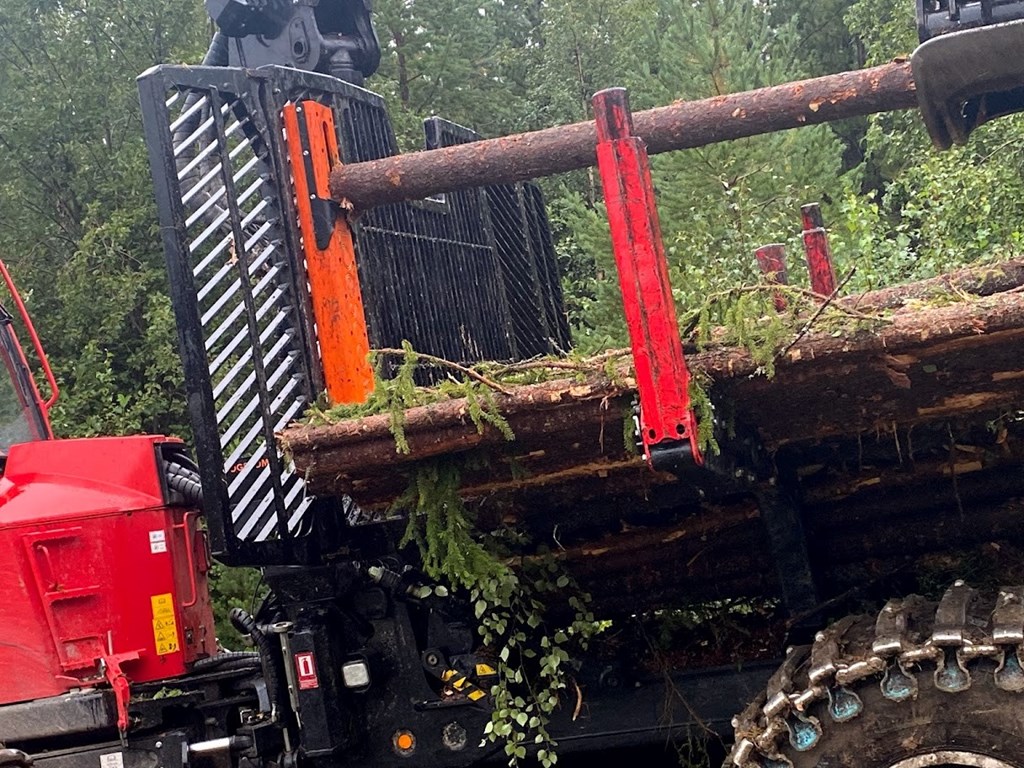
Integrated solution in the forestry machine. Logscom's system is built directly into the machines, enabling timber tagging without manual handling.
Expanding Beyond Sweden
Logscom has also taken steps beyond Sweden. In Norway, 30–40 systems are already in operation.
“There, it's mainly contractors who have discovered the time savings and work environment benefits. The digital capabilities will attract more players moving forward.”
With hundreds of machines in operation, large amounts of data are collected every day.
“We may have around 200 machines together tagging roughly a thousand logs per hour.”
This creates new opportunities to understand timber at a highly detailed level.
“If you can connect a log to the exact place where it grew, and then combine that with data from sawmill X-ray systems, you can start predicting properties and optimize how the tree is cut already in the forest,” he says.
The goal is to maximize the value of every tree while using resources more intelligently.
“That's where we believe a data-driven approach will make a major difference. And that's where we're helping drive development forward.”
Click here to learn more about Logscom!
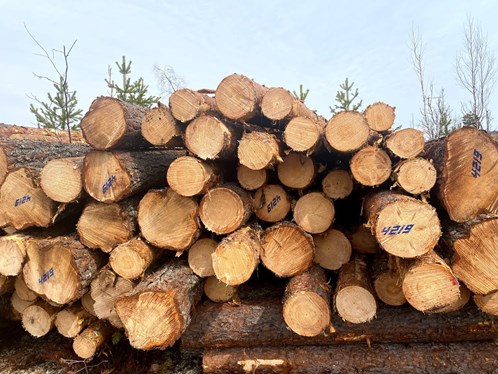
Caption header: Logs are tagged directly in the field. With automated timber tagging, each log is connected to data about its origin and handling – a key to traceability throughout the entire value chain.