
Lundqvist Builds a Global System – With the Customer at the Drawing Board
The sawmill burned down in 2004. That became the starting point for what Lundqvist Trävaru is today: a company operating in Sweden, Norway, the United States, and New Zealand – with a digital tool that allows customers to design their own house and see the price instantly.
Lundqvist traces its roots back to the 1930s. Over the years, the business has taken many forms – a local sawmill, furniture workshop, sawmill, and timber planing operation. But what was rebuilt after the fire is something entirely different today.
When Samuel Holmström joined in 2010, the company's turnover was around SEK 10 million. Today, he is CEO and, together with Jens Lundqvist – third generation of the founding family and responsible for digital development – has helped drive the transformation. During the pandemic, turnover peaked at SEK 240 million.
"We realized there was a highly flexible building system at the core – like Lego bricks. It could be combined and adapted to everything from holiday homes to larger buildings," says Samuel Holmström.
The modular system became the foundation. But it was not until digital tools were added that things really took off.
"If you can build houses in a game like The Sims, it should be possible in real life too – that's where we started," he says.
Since then, the company has received multiple awards for its digital innovation and user-friendly solutions.
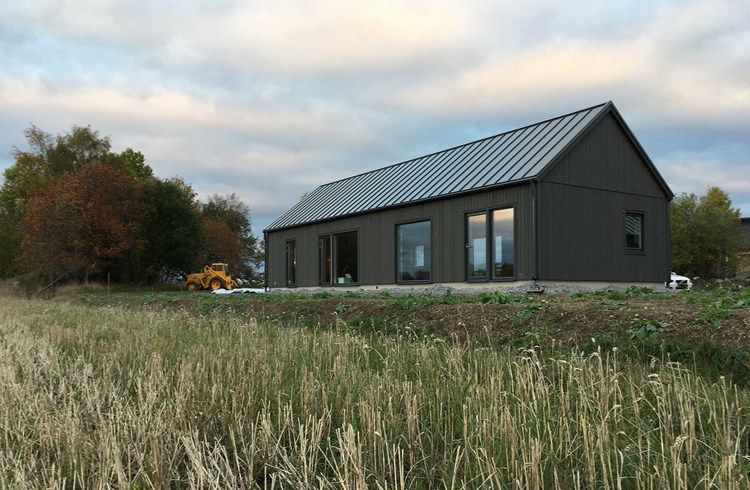
With a modular building system and a digital tool, customers can design their own house.
"We Have Built an Ecosystem"
Instead of purchasing an expensive solution, the company began developing its software in-house together with students. The first prototype was created as part of a thesis project. Since then, more than 280 students have been involved in various initiatives.
Today, the customer journey begins in the digital tool. Customers can design their building from scratch, move walls, add windows, and instantly see how the price changes. They can also start from other customers' designs as ready-made templates.
"You shouldn't have to understand the construction – you should be able to focus on what you want it to look like, and we'll take care of the rest," he says.
Customer journeys vary. Some experiment for a long time, while others know exactly what they want. In some cases, Lundqvist has had little to no contact with the customer before the order is placed.
At the same time, the business model has evolved. Today, manufacturing accounts for about 30 percent of revenue. The rest comes from services and a network of around 220 construction companies across Sweden involved in projects.
"We've built an ecosystem instead of doing everything ourselves."
Of the company's 42 salaried employees, around ten percent work in programming. More people are based in the office than in the factory.
Less Administration – More Time with the Customer
When everything is gathered in one system, much of the manual work disappears. This also changes the customer dialogue.
"We no longer have to copy and paste data. Instead, we can spend time talking to customers, which makes the whole process easier for them. We receive high customer satisfaction ratings," says Samuel.
Simplicity, pricing, and customer interaction are highlighted as key factors.
Wood is a natural part of the offering, but sustainability efforts also focus on how projects are planned.
"We know what's needed going forward and can coordinate purchases. That significantly reduces waste," says Samuel.
Lundqvist also acts as an investor and early adopter of new solutions in the construction sector. One example is building boards made from recycled milk cartons.
"There are many great new products, and we try to be an early customer to help get their business moving."
Lundqvist's International Journey
In recent years, Lundqvist has expanded beyond Sweden, with the United States being the most developed market. The company now operates in Connecticut, where both sales and production are growing. Around ten houses have been delivered in New Zealand.
At the same time, Samuel Holmström points to additional markets ahead.
"Canada and the UK are interesting. But it's not just the building system that's in demand – it's the digital solution as well."
This has led Lundqvist, in some cases, to take ownership stakes and license the platform.
After a few challenging years in the construction industry, there are now clear signs of recovery – something that is immediately visible in the tool.
"We see more people going in and start designing. Interest is increasing."
Looking ahead, the focus is on continuing to build – both the business and the surrounding networks.
"We have a strong position with end customers today. But we also see the value of more international connections, especially related to the digital side."